登入
|
註冊
|
會員中心
|
結帳
|
培訓課程
魔法弟子
|
自資出版
|
電子書
|
客服中心
|
智慧型立体會員
書名
出版社
作者
isbn
編號
5050魔法眾籌
|
NG書城
|
國際級品牌課程
|
優惠通知
|
霹靂英雄音樂精選
|
多變量分析方法:統計軟體應用(第六版)
此作者無相關書籍
文學小說
文學
|
小說
商管創投
財經投資
|
行銷企管
人文藝坊
宗教、哲學
社會、人文、史地
藝術、美學
|
電影戲劇
勵志養生
醫療、保健
料理、生活百科
教育、心理、勵志
進修學習
電腦與網路
|
語言工具
雜誌、期刊
|
軍政、法律
參考、考試、教科用書
科學工程
科學、自然
|
工業、工程
家庭親子
家庭、親子、人際
青少年、童書
玩樂天地
旅遊、地圖
|
休閒娛樂
漫畫、插圖
|
限制級
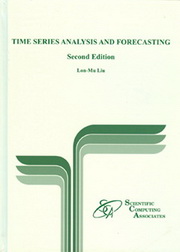
Time Series Analysis and Forecasting Update 2/E 2009
作者:
Liu, Lon-Mu
分類:
財經投資
/
統計
出版社:
雙葉書廊
出版日期:2009/5/1
ISBN:0976505681
書籍編號:kk0240091
頁數:574
定價:
690
元
書價若有異動,以出版社實際定價為準
暫停販售
暫無供應商:尋找供貨商中(也有可能出版社已結束)。
團購數最低為 20 本以上
評價數:
(請將滑鼠移至星星處進行評價)
目前平均評價:
文字連結
複製語法
<a href='https://www.silkbook.com/book_detail.asp?goods_ser=kk0240091'>Time Series Analysis and Forecasting Update 2/E 2009</a>
圖片連結
複製語法
<a href='https://www.silkbook.com/book_detail.asp?goods_ser=kk0240091'><img src='https://www.silkbook.com/mall_image/bk/kk0240091.jpg' ALT='Time Series Analysis and Forecasting Update 2/E 2009' height='120' width='90'></a>
分
享
內容簡介
作者介紹
同類推薦
Time Series Analysis and Forecasting Update 2/E 2009 Time series analysis and forecasting have become increasingly important in many fields of research and application. The goal of this book is to distill and integrate current research results into cohesive and comprehensible methodologies, and to provide a streamlined approach to time series analysis and forecasting. This book is written in a manner which is suitable for a two-semester course in applied time series analysis and forecasting. It can be used in a one-semester course by excluding more advanced topics in the later chapters. The material is targeted to advanced undergraduate and graduate level students in various fields of study. With its emphasis on practicality and applicability of methodologies, the book is also useful as a reference source for researchers and practitioners in time series analysis and forecasting. In addition to traditional Box-Jenkins methodology, this book places greater emphasis on these newer issues, such as modeling automation, outliers, heteroscedasticity, and nonlinearity , as well as multivariate approaches in time series analysis and forecasting. More details regarding the contents of the book can be found in http://www.scausa.com/toc.htm . 目錄 Ch01 Introduction 1.1 Time Series Data 1.2 Application of Time Series Analysis 1.3 Approaches for Time Series Analysis and Its Applications 1.4 Model Building and Forecasting 1.5 Evaluation of Forecast Performance 1.6 Outline of This Book Ch02 Autoregressive Integrated Moving Average Models 2.1 Stationary Time Series and Their Characterization 2.2 Important Notations 2.3 Stationary Time Series Models and Their Characteristics 2.4 Partial Autocorrelation Function(PACF) 2.5 PACF for Stationary Time Series Models 2.6 Extended Autocorrelation function(EACF) 2.7 Sample EACF for Stationary Time Series Models 2.8 Nonstationary Models 2.9 Model Building 2.10 Model Identification 2.11 Model Estimation 2.12 Diagnostic Checking 2.13 Forecasting 2.14 Additional Example Ch03 Seasonal Arima Models 3.1 Seasonal Time Series Data and Notations 3.2 Stationary Seasonal Time Series Models and Their Characteristics 3.3 PACF and EACF for Stationary Seasonal Time Series Models 3.4 Nonstationary Seasonal Models and Their Characteristics 3.5 Multiplicative and Nonmultiplicative Seasonal Models 3.6 Model Identification 3.7 Model Estimation 3.8 Diagnostic Checking 3.9 Forecasting 3.10 Illustrative Examples Ch04 Arima Modeling Using Expert Systems 4.1 The Univariate ARIMA Model 4.2 Automatic Identification of ARIMA Models for Nonseasonal Time Series 4.3 Identification of Seasonal ARIMA Models Using a Filtering Method 4.4 An Example: Quarterly Nominal GNP of the United States 4.5 Additional Examples and Simulation Studies Ch05 Transfer Function Models 5.1 Transfer Function Models 5.2 Transfer Function Model Identification 5.3 Transfer Function Model Estimation 5.4 Diagnostic Checking of an Estimated Transfer Function Model 5.5 Forecasting 5.6 Additional Illustrative Examples Ch06 Analysis of Time Series with Calendar Effects 6.1 ARIMA Models with Calendar Variation 6.2 Identification of ARIMA Models of the Disturbance Term 6.3 An Example of Model Identification in the Presence of the Trading Day Effects 6.4 An Example of Model Identification in the Presence of the Holiday Effects 6.5 Discussion Ch07 Intervention Analysis and Outlier Detection 7.1 Models for Intervention Analysis 7.2 Examples of Invention Analysis 7.3 Forecasting with an Intervention 7.4 Outliers in a Time Series 7.5 Methods for Outlier Detection and Adjustment 7.6 An Example for Joint Estimation of Outlier Effects and Model Parameters 7.7 Intervention Analysis in the Presence of Outliers 7.8 Forecasting in the Presence of Outliers 7.9 Modeling and Forecasting Time Series in the Presence of Missing Observations Ch08 Forecasting Using Exponential Smoothing Methods 8.1 The Na臈ve Methods 8.2 The Averaging Methods 8.3 Simple(Single)Exponential Smoothing 8.4 Double Exponential Smoothing 8.5 Holt’s Two Parameter Exponential Smoothing 8.6 Winters’ Additive Seasonal Exponential Smoothing Method 8.7 Winters’ Multiplicative Seasonal Exponential Smoothing Method 8.8 General Exponential Smoothing Using Seasonal Indicators 8.9 General Exponential Smoothing Using Harmonic Functions 8.10 Forecasting Using Exponential Smoothing Methods in Comparison to ARIMA Modeling Ch09 Time Series Data Mining 9.1 Data Mining 9.2 Time Series Data Mining on Electricity Loads 9.3 An Example of Business Operation and Data Mining Applications 9.4 Methodology for Data Mining and Knowledge Discovery in Time Series 9.5 Data Mining at the Corporate Level and Its Applications 9.6 Discussion Ch10 Power Transformation and Forecasting 10.1 Power Transformation of a Time Series 10.2 Retransformation of power Transformed Forecasts 10.3 Procedures for Searching a Power Transformation 10.4 Remarks on Power Transformation Ch11 Time Series Models with Heteroscedasticity 11.1 An Example of Time Series with Heteroscedasticity 11.2 The ARCH Model 11.3 The GARCH Model 11.4 Building an ARCH/GARCH Model 11.5 The Integrated GARCH(IGARCH) Model 11.6 The GARCH-M Model 11.7 Asymmetric Garch Models 11.8 The Conditional Heteroscedastic ARMA(CHARMA) Model 11.9 The Stochastic Volatility(SV) Model 11.10 Regression Plus GARCH Extension Ch12 Segmented Time Series Modeling and Forecasting 12.1 Model Estimation Using Weighted Method 12.2 Modeling and Forecasting Seasonal Time Series 12.3 Modeling and Forecasting Daily and Hourly Time Series 12.4 Threshold Transfer Function Models 12.5 Threshold Autoregressive Modeling and Forecasting Ch13 Nonlinear Time Series Models 13.1 Threshold Autoregressive Models 13.2 Nonlinearity Test 13.3 Identification of Threshold Values Ch14 Multivariate Time Series Analysis and Forecasting Using Vector ARMA Models 14.1 Vector ARMA Models 14.2 Examples of Vector Models 14.3 Relationship between Vector ARMA Models and Other Time Series Models 14.4 Characteristics of Some Vector ARMA Models 14.5 Partial Autoregression Matrices in Vector Models 14.6 Extended Cross Correlation Matrices(ECCM) 14.7 Building Vector Models 14.8 Forecasting Using Vector ARMA Models 14.9 Multiplicative Seasonal Vector ARMA Models 14.10 Analysis of Actual Time Series 14.11 Eigenvalue-Eigenvector Analysis in Multivariate Time Series 14.12 Alternative Approach to Modeling Multiple Time Series Ch15 Multivariate Time Series Analysis and Forecasting Using Simultaneous Transfer Function Models 15.1 Simultaneous Transfer Function Models 15.2 Structural Form and Reduced Form Models 15.3 Model Building Strategy for Reduced Form STF Models 15.4 Model Building Strategy for Structural Form STF Model 15.5 Additional Illustrated Examples 15.6 Multivariate Time Series Analysis and Forecasting with Interventions 15.6 Econometric Modeling Using STF Models Ch16 Causality Analysis 16.1 Dynamic Relationship between Economic Time Series 16.2 A Decision Tree Approach for Detecting Dynamic Relationship 16.3 Illustrative Examples 16.4 Other Procedures for Causality Testing
被「包裝」的數據,破
Global Bus
探索感官資料:深入市
不懂公式也OK!用統
JASP統計分析與實
別怕!零基礎的財務報
看圖秒懂!社會人必修
今天能賣多少球?從冰
薯條每包有幾根?從漢
極簡貝氏統計學
為了保障您的權益,新絲路網路書店所購買的商品均享有到貨七天的鑑賞期(含例假日)。退回之商品必須於鑑賞期內寄回(以郵戳或收執聯為憑),且商品必須是全新狀態與完整包裝(商品、附件、內外包裝、隨貨文件、贈品等),否則恕不接受退貨。